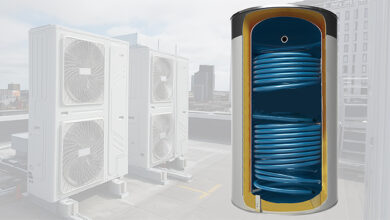
Hot Water Out of Thin Air
Simon Bennett, senior applications engineer, Adveco, considers the practical challenges of specifying air source heat pumps to meet public sector hot water demands…
Within the Government’s ten-step plan for a ‘Green Industrial Revolution’ is an aggressive target to install 600,000 heat pumps every year by 2028, “to make homes, schools and hospitals greener, warmer and more energy efficient.” The Prime Minister’s singling out of schools and hospitals reinforces the challenge the public sector organisations undoubtedly face integrating heat pumps, which are able to draw and transfer thermal energy from air, in the push toward greater sustainability.
Due to their relative ease of installation we will focus on Air Source Heat Pumps or ASHPs. However, with ASHPs offering greater efficiencies in low-temperature systems, the high-temperature demands of domestic hot water (DHW) for commercial applications can be a challenge.
When analysing the value of an ASHP in terms of reducing CO₂ emissions the carbon intensity figures from SAP10 should be used. Electricity can be evaluated as being like-for-like with natural gas – once the operational efficiency has been factored in. The advantage of ASHPs is that their performance is greater than 100% as they extract additional energy from outside of the building’s metered systems. This gives significant carbon savings but, when describing the efficiency of an ASHP, working flow water temperatures of 35°C are often cited. It needs to be recognised that this temperature is insufficient for commercial applications. Even if a commercial building has achieved Passivhaus standards, and this remains a rarity, 35°C is not going to be hot enough to safely provide DHW. For this reason, it is recommended to calculate emissions at a working water temperature from the ASHP of 55°C, this is then hot enough to provide realistic levels of preheat for a commercial DHW system.
Achieving 60°C in a calorifier is a basic requirement for a commercial DHW system, but means the working flow temperature from the ASHP would need to be at least 65°C. A working flow of 55°C is certainly attainable from current generation ASHPs and this is why when designing commercial DHW systems it is preferable to use a hybrid approach that uses the ASHP as preheat and combines it with either gas-fired or electric immersion top up to achieve the required hot water temperature.
ASHPs typically have a 5K temperature differential (55°C flow vs 50°C stored) compared to 20K Delta (80°C flow vs 60°C stored) of gas-fired boilers. This means lower flow temperatures generated by an ASHP lead to around a 50% drop in energy transferred which demands an increase in the size of a system. Deploying ASHP for DHW therefore requires a different approach if we want to avoid operating at less than full capacity.
Rather than using a calorifier, an ASHP system would be better suited by employing a plate heat exchanger (PHE) with low temperature hot water (LTHW) and DHW buffer as a neutral/mixing point. By using a PHE, with its larger heat transfer area it is now possible to transfer all the energy that the heat pump can produce with reduced sized pump and pipework, whatever the weather.
Commercial DHW applications using heat pumps are going to be complex and, compared to gas-fired alternatives, are going to have higher up-front costs. Designing the system for peak efficiency and correctly calculating reductions in CO₂ emissions to achieve sustainability is a must to help offset this additional capital investment.
Correctly identifying a project’s location within the Ecodesign established European temperature zones is also key when assessing the suitability of a heat pump to serve a building’s heating load. For most of the UK the defined temperature zone is ‘average’, where the annual reference temperature for the ASHP’s Seasonal Coefficient of Performance, or SCOP, is -10°C. For some Southern and Western UK regions, the ‘warmer’ Ecodesign temperature zone can be applied for modelling, where the lowest the reference temperature will only fall to 2°C. These differing temperature regions can have a significant impact on the SCOP therefore it is important to ensuring the values entered into an assessment are both relevant and accurate for the installation. Incidentally, the SCOP of an ASHP is a far better overall gauge of the year-round efficiency as opposed to Coefficient of Performance (COP). While COP figures are often cited in technical literature, you must remember that these represent very specific climatic conditions that may only occur for a moment in time.
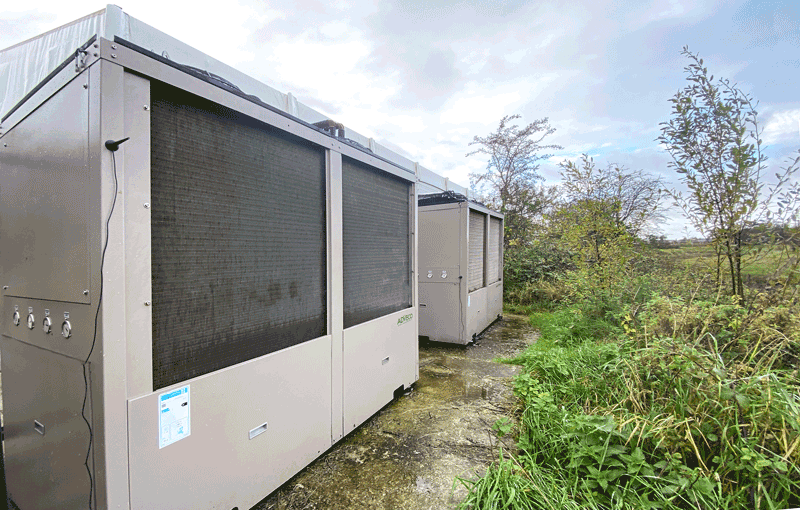
As an example, the Adveco L70 ASHP is designed with UK temperature variance in mind, capable of operating between -20°C and +35°C. At a reference temperature of -10°C the heat pump operates with a SCOP of 2.84 and it can still easily generate working water temperatures of up to 55°C and will reduce CO₂ emissions by almost 63%. Under the warmer climate zone’s conditions emissions can be reduced by over 72% when calculating with a SCOP of 3.82.
Heat pumps are not a new technology, but advancements have made their application for public sector projects more viable in recent years. Correctly sized, they can provide a more sustainable way to meet DHW demands. Commercial projects do however come with added complexity, meaning heat pumps alone are not yet a ‘silver bullet’ response to a sustainable future.