Office design – what comes naturally
Joint managing director and co-founder of award-winning design and workplace consultancy, Office Principles, Cyril Parsons considers the various means in which the workplace can deliver when it comes to biophilic design.
As the office has evolved and we take on a more people-focused approach to its design, biophilia is gradually becoming a part of the modern office psyche. As a style of design, it is certainly gaining traction, with architects and designers starting to view it as an integral part of any commercial and public building blueprint.
Initially coined by psychologist Eric Fromm in 1964, the term ‘biophilia’ was and is a reference to the human need and desire to connect to nature. In the commercial world, biophilic design is rooted in the consideration of the office as a community and many of us are consistently turning to biophilic references and styles in order to create the most desirable working environments for our clients.
The collective goal is to create spaces that will bring workers in to the office, supporting social integration and communal wellbeing, while helping them to engage with each other and their surrounds. Biophilic design is commonly recognised as a key factor in helping to realise that intent.
Developing community and neighbourhoods
Building a community in the office automatically enables a sense of belonging; communities invite people to be a part of something; working together and in support of each other; inspiring individuals to want to be a part of the whole. By offsetting the rigorous digital working practice that we are surrounded by and enhancing our feelings of connectivity, biophilic design provides the canvas for this community.
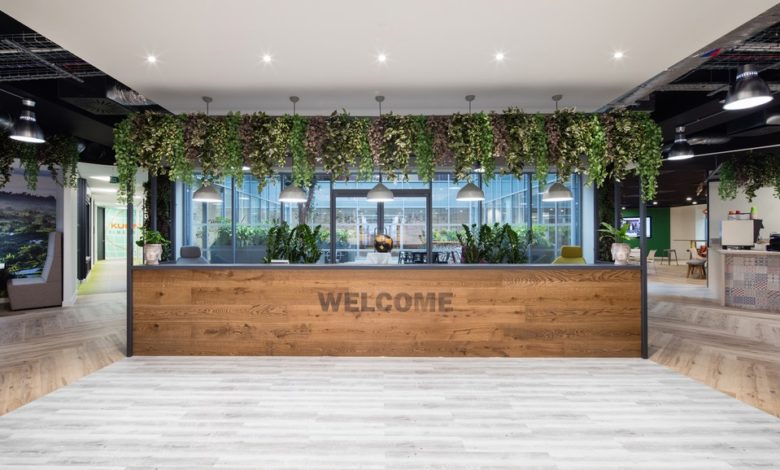
Community is made up of neighbourhoods and the word ‘neighbourhood’, in itself, conjures up an inclusive, warm and friendly approach. The concept of neighbourhood, in the office environment, involves the mimicking of the exterior physical prototype of parks and streets, lined with trees, by introducing plants and foliage that can emulate the complexity and integration of the natural world.
We can use living walls, planters and water features, instead of floor coverings and panelled dividers, to mark out neighbourhoods and distinguish certain areas. Such markings encourage free movement and allow for a more natural flow of foot traffic around the office space.
Different manifestations of biophilic design that can be used in these areas include everything from natural light, plants and living things to pictures of nature and beaches etc. We can also opt for natural and organic fabrics and materials, along with reclaimed bricks, stone and wood in the initial design stages.
A healthier outlook
BRE states that 60 per cent of office staff don’t have enough access to sunlight. Given that statistic, and many more like it, the first step for architects and designers has to be to assess the access to natural light and look for ways to increase it. The urban environment separates us from the natural world and positions a lot of us in an office for eight hours a day so any way to bring the outside in is a bonus.
Focusing on natural light is also likely to help with any biophilic elements that are worked into the office’s design.
Recreating as much of the outdoors inside as possible is next on the agenda.
All greenery and vegetation provides us with health and wellbeing benefits, including longer life expectancy and improved mental health. There’s also evidence that the presence of plants in a commercial environment can act as a force to protect against potentially dangerous ingredients.
Raconteur, the business publisher, in an article outlining the benefits of biophilic design, references research carried out by Norway’s Agricultural University in Oslo. This research indicates that plants remove harmful organic compounds, such as benzene and formaldehyde, that are found in furniture, carpets and the paint in many commercial buildings.
Putting nature in the mix
If you don’t have the resources to copy the style of Amazon, with its glass-domed greenhouses, then plants, flowers and living walls make for a considered choice.
For those who haven’t an abundance of space or budget, there’s always the option to
supply as varied and as large a collection of plants as possible. Workers can be invited to choose and bring in their own desk plants. Giving staff responsibility for certain areas –owning plants and elected spaces – is far more likely to prove to be a workable concept in the long run.
From CSG International and Adobe in Bangalore to Apple in California and Amazon in Seattle, there are a whole host of big corporates, who have had the funds to pay for grand designs, to take inspiration from. For those who have greater ambition (and budgets to match !), there are no limits to the sensory celebrations out there to feast on and admire.
There is potential, ultimately, for all office environments, regardless of size of funds or floor space, to embrace biophilia and introduce living elements into the workplace environment.
It makes sense to include nature and natural elements in the design as we are far more likely to fuel the collaborative, people-driven approach to which both clients and end-users aspire by putting ourselves at one with nature – and with each other.