Specifying Low-Carbon Hot Water for the UK Public Sector: Legislation, Decarbonisation, and Glass-Lined Cylinder Selection
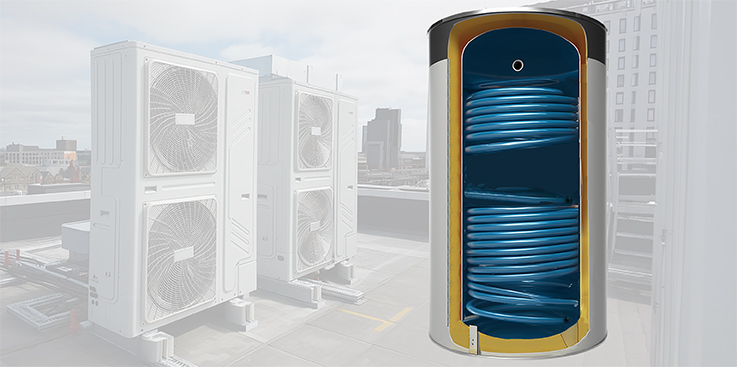
In the UK public sector, the delivery of hot water is much more than a routine operational requirement. It is a strictly regulated utility where system failure directly impacts public health, safety, and institutional continuity. Whether handling the continuous demand of a large acute hospital or the sharp, intense peak loads of a secondary school during scheduled break times, public sector hot water systems require massive storage volumes, rapid thermal recovery, and exceptional system resilience.
Simultaneously, public sector estate managers operate under the binding target of the UK’s Net Zero mandates. Driven by the Public Sector Decarbonisation Scheme (PSDS), estates must systematically move away from fossil-fuelled direct gas systems toward indirect, low-carbon hybrid platforms. Navigating this transition while adhering to rigid health, safety, and water-quality legislation requires a careful approach to specifying water heating plant. Here, high-quality, glass-lined carbon steel commercial cylinders emerge as a highly efficient, compliant, and cost-effective response.
The Legislative Framework
Public sector installations must strictly satisfy the UK Building Regulations to safeguard occupants and ensure efficient system operation.
As public sector estates modernise, they overwhelmingly favour unvented hot water systems over traditional, gravity-fed vented configurations. By connecting directly to the mains water supply, unvented cylinders deliver exceptional mains-pressure performance across multiple floors and outlets simultaneously – essential for high-occupancy environments. However, because these systems are closed and pressurised, they fall under the rigid statutory requirements of Section G3 of the Building Regulations.
An unvented cylinder installation must incorporate independent safety devices to prevent the stored water from ever exceeding 100°C. These include temperature and pressure relief valves, expansion vessels, non-self-resetting energy cut-outs, and dedicated discharge pipework (tundishes). Under UK law, these systems must be designed, installed, and commissioned by G3-certified competent engineers to guarantee system safety and statutory compliance.
Part L mandates tighter environmental and conservation standards for non-domestic buildings. Direct-fired, non-condensing fossil fuel water heaters have effectively been phased out. For indirect water heaters – also known as calorifiers – connected to external heat sources, the regulations specify a minimum heat generator seasonal efficiency of 91%. This environment shifts the technical preference toward highly insulated indirect cylinders that minimise standby heat loss.
Pathogen Control
The primary challenge in public sector hot water design is balancing effective biological disinfection with strict anti-scalding safety. Waterborne pathogens, particularly Legionella pneumophila and Pseudomonas aeruginosa, present a severe risk to vulnerable populations in hospitals and schools.
To comply with the Health and Safety Executive’s (HSE) Approved Code of Practice (ACoP) L8 and HSG274 Part 2, domestic hot water (DHW) must be stored at a minimum temperature of 60°C to rapidly eliminate bacterial accumulation, and distributed such that it reaches at least 50°C (55°C in healthcare facilities) within one minute at the outlet.
For NHS trusts and healthcare providers, the Department of Health issues the highly prescriptive HTM 04-01 guidance (Safe water in healthcare premises). To prevent Legionella proliferation, HTM 04-01 demands that commercial cylinders eliminate internal temperature stratification, cool zones at the bottom of the tank where bacteria flourish. Consequently, healthcare-compliant cylinders must incorporate automated destratification pump circuits to maintain a uniform 60°C temperature throughout the entire water volume.
Because distributing water at 55°C to 60°C creates an extreme scalding hazard for young children, elderly patients, or vulnerable adults, the regulations mandate point-of-use protection. High-temperature water from the cylinder must be blended down at the tap using certified Thermostatic Mixing Valves (TMVs). In healthcare environments, these must comply with the strict D 08 performance specification (TMV3 approval), while educational facilities typically implement TMV2-certified valves to prevent accidental injury.
Water Chemistry and Compliance
Specifying engineers must align cylinder material selection with regional water chemistry across the UK. In hard water areas (South East, East Anglia, Midlands), direct electrical immersion elements suffer from rapid limescale encrustation, which acts as a thermal insulator, reduces efficiency, and causes premature structural damage. Utilising an indirect cylinder remedies this. The cylinder deploys an internal heat exchanger coil connected to an external heat source. Because the primary heating fluid is sealed within the coil, the surface temperature facing the raw mains water is lower and more uniform than a direct immersion element, significantly reducing limescale formation.
In other UK regions (Scotland, Wales, North West England) softer water lacks dissolved minerals and is naturally more corrosive to bare metal. Under these conditions the choice has been limited to high-grade, and therefore costly stainless steel tank. However, for many public sector projects operating under strict capital expenditure restrictions, choosing high-quality carbon steel cylinders with an inorganic blue enamel lining (glass-lined) and an integrated magnesium sacrificial anode can now also provide corrosion resistance and compliance with UK water regulations without the premium upfront cost of stainless steel.
Decarbonisation and Hybrid Renewable Design
To meet modern carbon-reduction targets, public sector buildings are rapidly integrating low-carbon primary heat sources like Air Source Heat Pumps (ASHPs) and solar thermal collectors. However, heat pumps operate with maximum seasonal efficiency when generating lower baseline flow temperatures (typically 45°C to 55°C). This creates a direct conflict with the ACoP L8 requirement to store water at 60°C+.
To bridge this regulatory gap, public sector system designers deploy dual-coil indirect cylinders and buffer vessels in hybrid configurations. In a dual, or twin-coil arrangement, the lower internal coil is fed by the low-carbon air source heat pump, providing high-efficiency pre-heating up to approximately 50°C. The upper internal coil is connected to a traditional gas or electric boiler, providing the mandatory high-temperature ‘top-up’ to raise the water to 60°C for biological pasteurisation.
Because heat pumps operate inefficiently if they cycle on and off frequently to meet intermittent demand, an insulated buffer vessel will be integrated, allowing the heat pump to operate for longer, highly efficient periods. This is possible by storing thermal energy and discharging it smoothly when building demand spikes. Think of the buffer cylinder as the battery in a low-carbon hot water system.
To address these multi-layered public sector demands, Adveco has released the comprehensive VB range of glass-lined carbon steel storage vessels. Engineered to withstand demanding UK water conditions, the range accommodates maximum working pressures up to 8 bar and peak operating temperatures of 85°C.
Every VB vessel is lined with a high-grade, corrosion-resistant inorganic blue enamel and includes a magnesium sacrificial anode as standard. Maintenance and statutory inspections are simplified via a prominent, leak-resistant front-facing clean-out flange, enabling estates teams to easily monitor internal scale accumulation. Thermal efficiency is maximised using 100mm high-density insulation to minimise standby heat loss, aligning directly with Part L asset ratings.
The range includes three tailored configurations for public sector specification:
VBI (Indirect / Preheat) available from 200 to 3000 litres. The VBI supports all-electric public sector retrofits. It accepts heavy-duty direct electric immersion heaters from 3 to 36 kW alongside secondary backup immersions (3 to 6 kW), providing full thermal backup and automated high-temperature pasteurisation functionality to meet L8 mandates.
VBT (Twin-Coil Calorifier) ranging from 200 to 3000 litres. The VBT features low- and high-level fixed internal coils. This is the definitive choice for hybrid public sector systems, allowing a renewable heat pump to manage baseline pre-heating via the lower coil, while a secondary boiler tops up the heat via the upper coil.
VBB (Single-Coil Buffer) available from 200 to 2000 litres. The VBB provides dedicated thermal buffer storage with a low-level coil. It optimises heat pump cycle times while retaining the flexibility to accept a 3 to 36 kW electric immersion for emergency system resilience.
By pairing robust, glass-lined indirect architecture with intelligent hybrid system design, UK public sector operators can securely balance strict legislative compliance, robust pathogen control, and aggressive carbon-reduction targets.