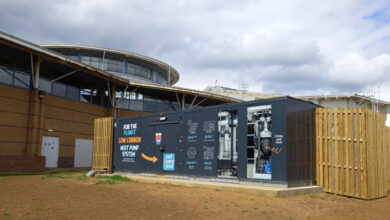
Decarbonising a diverse European building stock.

Bringing down emissions from buildings to zero might be the hardest nut to crack for the European Green Deal. With heating and cooling in buildings responsible for 40% of energy consumption and 36% of emissions, the importance of its decarbonisation is paramount.
As the current annual renovation rate is below 1% and more than 70% of heating in buildings is supplied by old and inefficient boilers, buildings are unanimously recognised as a hard-to-decarbonise sector by the European Renovation Wave Strategy published in October 2020, the European Union (EU) Energy Efficiency Directive (EED)and various strategies of individual European Member States.
Due to the heterogeneity of the building stock and climatic conditions in Europe, a one-solution-fits-all approach will bring more headaches than benefits. A range of solutions will be needed to supply efficient and increasingly renewable heat to and in buildings. It will include reducing demand, direct electrification, district heating, high-efficiency combined heat and power, waste heat, solar thermal, and geothermal.
The choice between different decarbonisation solutions will largely depend on the seasonality of heat demand, the variability and limited capacity of renewable electricity supply, constrained electricity grids, customer preferences and the costs. Direct electrification with heat pumps is not always economically feasible in every building and will double the peak demand for electricity in winter in most European countries.
Therefore, the efficient use of hydrogen and renewable gases in buildings will be needed. In this regard, cogeneration, which combines the generation of heat and electricity in a single unit to be more efficient, will play a key role to complement an increasingly electrified and renewable energy system. This could be done via district heating combined with large-scale cogeneration or via micro-cogeneration systems inside buildings.

The town of Hassfurt in Germany demonstrates how a cogeneration unit running on hydrogen can be at the centre of the city’s long-term decarbonisation strategy. The unit generates green electricity and heat, distributed via a district heating, for the town. The hydrogen comes from excess wind power. Local actors become self-sufficient to provide their buildings with green energy at any time of the year.
Domestic fuel cell units running on hydrogen are another way of supplying buildings with heat and electricity. Fuel cell micro-cogeneration (FC micro-CHP) systems are very energy efficient, thanks to a total efficiency of over 90%, allowing for a very cost-effective heat and power production. Furthermore, it turns energy consumers into prosumers giving them the flexibility to generate heat and electricity when they need it. Households and businesses can become largely independent from the grid with their own FC micro-CHP unit.
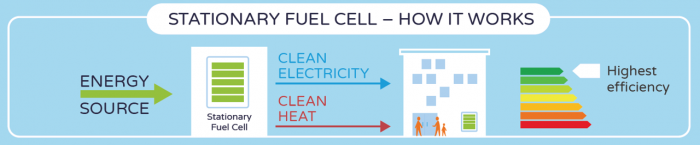
On the system level, several FC micro-CHP units can act as a power plant and cover residual electricity demand, at times of peak demand or insufficient wind and solar generation. By bringing the point of power generation and consumption closely together, up to EUR 2,000 of grid reinforcements can be avoided for each 1 kWel of micro-CHP installed.
Accelerating a deep decarbonisation of buildings will require a profound integration and decentralisation of our energy system. Hydrogen-based solutions can be a large and cost-effective contributor to that. With gas grids covering more than 50% of the energy needs in buildings across Europe today, we already have a wide network in place to deliver a decarbonised gas.
Several regions and authorities in Europe are supporting the uptake of hydrogen and fuel cells in buildings. You can sign the High Level Declaration on Stationary Fuel Cells for Green Buildings, initiated by the EU funded PACE and Comsos project, if you would like to become one of the signatories.
DISCLAIMER: All opinions in this column reflect the views of the author(s), not of EURACTIV Media network.