Education: A Strategy For Spreading Sustainability
As the government pushes for rapid adoption of net zero, the brunt of early development will inevitably fall to the government-funded public sector, in the latest policy paper, the government has outlined a vision for the United Kingdom to be the world-leading education sector in sustainability and climate change by 2030. Whilst the government has set out a broad holistic approach to addressing sustainability and climate change across the education sector, a considerable portion, through net zero and the need for resilience, directly addresses the buildings within the education estate.
Where To Begin?
To reduce energy usage and achieve legal targets for carbon emissions the education sector needs to get a better understanding of the scale of the problem. Schools and universities represent 36% of total UK public sector building emissions with costs being both significant and on the rise. Financial benchmarking shows schools alone were spending around £630m per annum on energy in 2019, with costs rising subsequently.
Adapting existing buildings and designing new ones to respond to climate change and reduce emissions presents a significant challenge. By standardising reporting for decarbonisation and climate resilience the government aims to develop evidence-based actions to support a reduction in energy demand and help adapt buildings to climate risks through innovation in construction that also deliver capital and operational savings. With increased legislation on net zero, consistent reporting will become a necessity. The government’s Net Zero Strategy commits to legislate reporting of emissions if insufficient progress is made voluntarily.
The government’s focus for education estates through until 2025 will involve evidence gathering and reporting on the various new technologies, innovation in sustainable building design, retrofit, and building management to supply further guidance in achieving net zero. Once a best value for money approach is decided upon the process of investment will accelerate.
New Builds
All new school buildings delivered by DfE which are not already contracted will be net zero in operation. They will be designed for a 2°C rise in average global temperatures and future-proofed for higher indoor temperatures should there be a 4°C rise. Moving forward, local authorities will need to consider environmental sustainability, carbon reduction and energy efficiency when planning to deliver new school capital projects.
The implementation of ultra-low carbon education buildings will be accelerated. By 2025 at least four schools and one college will have been built via the Gen Zero Platform that was demonstrated at COP26. Over time, all centrally delivered new-build projects are to be built using ultra-low carbon methods.
Existing Buildings
The building energy efficiency survey indicates that approximately 60% of energy use in education settings is associated with high carbon intensity fuels such as natural gas, coal and oil. Reducing demand for heating and hot water use, and/or delivering via more sustainable means is a critical need.
For existing buildings, the strategy begins with further trials of smart meters and energy management systems that can help reduce usage and operational costs. Improved collection and use of data on energy usage, water and heat will help to drive individual settings for education buildings.
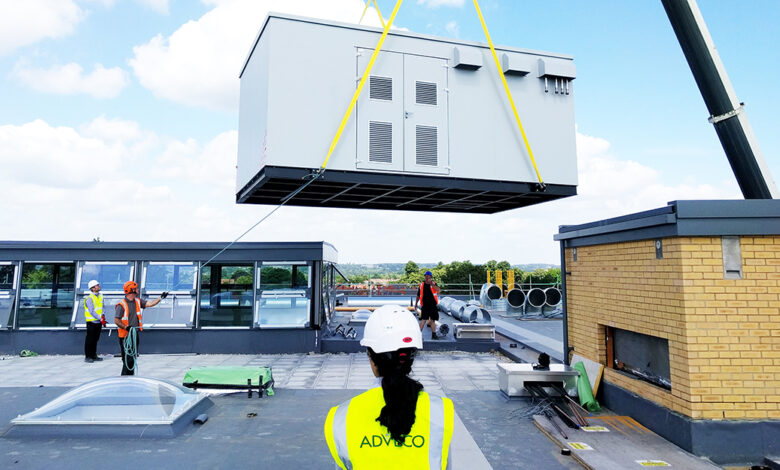
One approach being reviewed is to address sustainable heating and hot water by providing off-site manufactured, low-carbon, heating systems on the existing school and college estate. These ‘Energy Pods’, similar to Adveco developed packaged plant rooms, are viewed as a potentially strategic approach to safely deliver sustainability for the education estate.
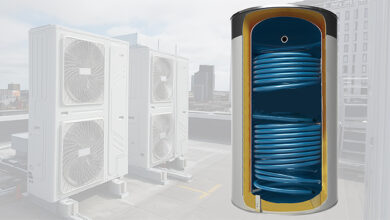
This year the government has also committed to testing the feasibility of replacing school boilers with ground or air source heat pump applications that can be upscaled to accelerate decarbonisation between 2025 and 2035 as part of a wider effort to replace fossil fuel heating systems with low carbon heating.
These projects will provide evidence for mitigating the causes of climate change, investigating the resilience of existing buildings and how their environmental conditions can be improved.
Learning From the Experts
As a specialist in the design and provisioning of domestic hot water (DHW) systems, Adveco has a long history of working with schools and centres of higher education to deliver more sustainable approaches. Addressing efficiency of hot water systems not only helps education meet sustainability goals in a practical and cost effective manner, it also delivers improved conditions for staff and the student body, providing access to better living and study spaces.
Beginning with solar thermal, Adveco has evolved its approach providing expert technical guidance on developing bespoke sustainable applications for estate buildings to encompass air source heat pumps, heat recovery, electric water heating and offsite construction to help achieve emission reduction targets.
In line with the new government strategy Adveco supports working together through site assessment programmes that use smart, embedded system monitoring to provide accurate real world data regarding current estate demands and energy consumption. This enhances application design and provides ongoing operational intelligence to improve energy efficiencies and create templates for sustainable operations across other education sites.
To help understand how elements of the government’s strategy for sustainable education can be quickly and cost-effectively implemented visit Adveco’s education resources for schools, academies, colleges and universities or contact us to discuss options for a site assessment to give you the accurate data you need to make a more educated decision on evolving hot water systems to be more sustainable.